Guide · Moisture & Kiln-Drying
Firewood moisture content and kiln-drying — the wholesale buyer's guide.
Moisture is a central firewood specification, but a useful order must also define how it is sampled, measured and documented. Tervete Wood operates 600 m³ of fully automated firewood kiln capacity supported by 2 MW heating; current product targets and records are confirmed in the commercial offer.
Write a measurable target
Define the required average, maximum sample and test method for the destination and sales channel.
Agree the sampling method
State where logs are sampled and which calibrated method will be used for acceptance.
Separate the documents
Moisture records, chain-of-custody claims and market certifications each prove different things.
Why moisture matters more than species
The difference between good and bad firewood is moisture, not species. A crate of birch at 15% moisture will outperform a crate of oak at 30% on the customer's stove — faster to light, cleaner burn, higher effective heat output.
This is why every European market has converged on moisture as the primary regulated spec. UK Ready to Burn, Nordic Swan, Irish Solid Fuel Regulations and most merchant procurement contracts all target sub-20% moisture as the working standard.
How moisture is measured
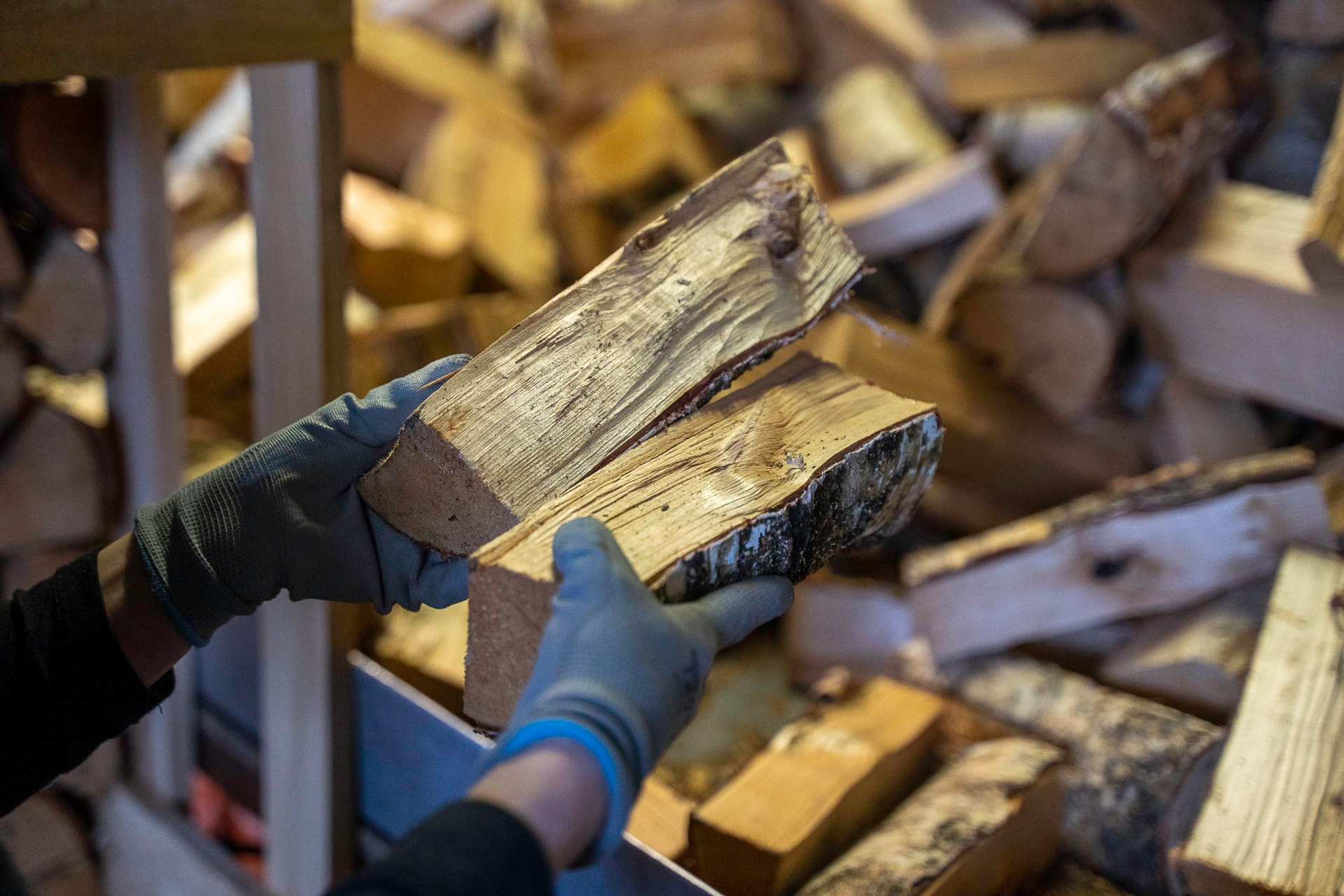
The industry standard is an electrical resistance meter with two probes pushed into a freshly split face at the mid-length of the log. Surface readings are meaningless — moisture lives inside the wood.
A useful order states the sample count, permitted average, maximum reading and acceptance method. Oven drying can provide a reference measurement, while calibrated resistance meters are commonly used for operational checks.
How kiln-drying actually works
A controlled drying process manages heat, airflow and time according to species, log dimensions and starting condition.
Tervete Wood operates 600 m³ of fully automated, firewood-specific kilns supported by 2 MW of heating power. Finished-product moisture targets, sampling and requested records are agreed directly with the buyer.
Why air-seasoning stopped being enough
Air-seasoning was the default across Europe for centuries. It still works — in a dry climate, over 18–24 months, air-seasoned hardwood can reach 20–25% moisture.
The challenge is consistency. Controlled drying gives the producer more influence over time, temperature and airflow, but the finished result still needs to be measured against the agreed order specification.
The energy penalty of wet wood
Burning firewood at 30% moisture wastes roughly 20–25% of the wood's energy evaporating water instead of heating the room. Sap and steam also condense in the flue, forming creosote — the primary cause of chimney fires.
Sub-20% kiln-dried wood delivers the rated kWh/kg (oak ≈4.2, ash ≈3.9, birch ≈3.3). Wet wood doesn't. This is the numeric case for kiln-dried at the customer's end of the transaction.
Storing kiln-dried firewood without losing spec
Kiln-dried hardwood is stable at sub-20% for 6+ months in dry, ventilated storage. Store crates off the ground on pallets or bearers, under cover (a roof, not a wrap), with airflow around all four sides.
Avoid sealing kiln-dried wood in plastic without vents — trapped moisture re-enters the surface layers. Rotate stock first-in first-out; the oldest crate on your yard should be the next one sold.
Certification schemes to know
Ready to Burn (UK): Woodsure-administered, mandatory for pack sizes under 2m³, certifies sub-20% moisture. Nordic Swan (SE/NO/DK/FI): broader environmental label including moisture, particulates and sourcing. Irish Solid Fuel Regulations: aligned with UK spec, under 20% moisture the practical merchant standard.
PEFC and FSC chain-of-custody systems address sourcing rather than moisture. Tervete Wood presents PEFC credential PEFC/12-31-065; it does not currently claim FSC certification.
Frequently asked
What moisture content should buyers specify?+
The correct requirement depends on the destination, sales format and applicable rules. State the required average, maximum sample and test method in the order.
How is firewood moisture measured?+
With a calibrated electrical resistance meter on a freshly split face — not the outer surface. Two probes are pushed into the wood mid-length, and the reading is taken at multiple points across a batch. Oven-drying to constant weight is the laboratory reference method but is rarely used in the trade.
How long does kiln drying take?+
Cycle time depends on species, starting moisture, dimensions, chamber design and the finished target. Ask the producer to confirm the applicable process controls.
Why use controlled drying?+
Controlled heat and airflow can improve repeatability compared with weather-dependent air drying and make production scheduling more predictable.
Does kiln-dried firewood re-absorb moisture?+
Only slowly, and only if stored badly. Kept dry and ventilated, kiln-dried hardwood stays under 20% for 6+ months. Store it off the ground, under cover, with airflow around the crates.
What's the energy penalty for burning wet wood?+
At 30% moisture, roughly 20–25% of the wood's energy is wasted evaporating water instead of heating the room. Kiln-dried sub-20% wood delivers the rated heat output; wetter wood does not.
Does a moisture record prove scheme certification?+
No. A test record reports measurements; certification confirms compliance with a named scheme. Request each document separately where needed.
How does kiln-drying affect heat output?+
It preserves it. The published kWh/kg figures for oak, ash, birch and alder all assume sub-20% moisture. Wetter wood underperforms those numbers; kiln-dried wood hits them.
Factory-backed supply
Tervete Wood is part of Agrolats Group.
Wholesalers buy directly from our factory, without middlemen. We bring 10+ years of firewood production experience and the backing of Latvia’s largest agricultural company group, with more than 40 companies across production, agriculture, forestry and livestock farming.
Company & credentials
A direct producer with a verifiable business foundation
Tervete Wood is a direct firewood producer in Tervete, Latvia, and part of Agrolats Group, Latvia’s largest agricultural company group. Wholesalers work directly with our production team, without middlemen, drawing on 10+ years of firewood production experience.
Agrolats Group reports 40 partner companies, more than 25 years of experience, over 500 employment opportunities created and more than 15,000 hectares of agricultural land managed. Tervete Wood benefits from that wider group foundation.
We process approximately 3,000 m³ of round timber and produce approximately 80 truckloads of firewood per month. Our factory uses a state-of-the-art Pezzolato splitting system, 2 MW of heating power and 600 m³ of fully automated, firewood-specific kiln capacity. Supply schedules and specifications are agreed with each buyer.
- Registered company
- SIA Tervete Wood
- Registration No.
- 40203731374
- VAT No.
- LV40203731374
- Legal address
- Brīvības iela 10B - 9, Dobele, Dobeles nov., LV-3701, Latvia
- Business model
- Direct firewood producer
- Group
- Agrolats Group
Chain of Custody
The credential supports documented chain of custody for wood sourced through the production supply chain.
Legal timber
Full EUTR due-diligence documentation supplied with every export shipment.
Export paperwork
Customs, phytosanitary and origin documents prepared per destination country.
GET IN TOUCH WITH US
Wholesale quotation
Tell us what your business needs. Buy directly from Tervete Wood’s firewood factory.